Discuss the steps necessary to make electronic evidence

Discuss the steps necessary to make electronic evidence

1) Identify and discuss the steps necessary to make electronic evidence admissible in court.1) Identify and discuss the steps necessary to make electronic evidence admissible in court.
2) Identify various crimes and incidents that are involved in electronic forensic investigations.
3) Discuss the importance of security and computer use policies.
4) Identify and discuss the techniques to obtain evidence from Internet and Web resources.
5) Identify and discuss the types of evidence that can be recovered from computer and electronic devices.
6) Discuss the importance of documentation and chain-of-custody in the forensic process.”
• APA Format with a least 10 references; plagiarism free, All paragraph must have the reference at the end of the paragraph. Para-phrasing with references is required.
• Make sure you are citing your sources. Use in-text citations when stating facts and make sure your sources is cited.
• Make sure you are defining all of your acronyms.

How software vulnerabilities can be exploited

How software vulnerabilities can be exploited

Objectives:

The main objective of this assignment is for the students to understand the security mechanisms in Unix-like operating systems and their interplay with software security, in particular:

– to learn practical access control mechanisms in Unix operating system, such as files and folder permissions and SUID programs, and how application security is affected by them;

– to learn how software vulnerabilities can be exploited to circumvent security mechanisms in both applications and operating systems.

Problem Description:

There are three problems in this assignment. To do this assignment, you will make use of an installation of Ubuntu Linux 12.04 (32 bit) in the Oracle VirtualBox virtual machine. The VirtualBox image of the Ubuntu installation is provided with this document and can be downloaded from the NTULearn site for this assignment, under the Group assignment menu. The assessment of the solutions to the problems listed below will be entirely done inside this particular installation of Ubuntu.

The Ubuntu installation for this assignment is a clone of the Ubuntu image provided for the tutorial sessions. In particular, it has the following users: admin, alice, bob, charlie, dennis, eve and fong.

User admin has the administrative privilege over the system, i.e., it can escalate its privilege to the root user.

The user bob maintains several applications that allows a user to access a certain ‘secret’, when the right password is provided. These passwords are different from the user account passwords. To distinguish the two, we shall call these passwords as application passwords. Every user is assigned a unique secret and a unique application password. The secrets take the form of a string of alpha numeric characters. The application passwords and the secrets are stored in individual files. The locations for these files are summarized in Table 1. The application passwords are strings of lower- case letters, of length at most 14 characters.

IMPORTANT NOTE: Appendix A provides the account passwords, the application passwords and the secrets for all users. All these passwords and secrets, except those for user ‘charlie’, will be changed during the assessment of your solutions. So your solutions must not hardcode any of these passwords and secrets other than charlie’s.

User name Application password file location Secret file location
admin /home/admin/Private/password /home/admin/Private/secret
alice /home/bob/Private/alice/password home/bob/Private/alice/secret
bob /home/bob/Private/bob/password home/bob/Private/bob/secret
charlie /home/bob/Private/charlie/password home/bob/Private/charlie/secret
dennis /home/bob/Private/dennis/password home/bob/Private/dennis/secret
eve /home/bob/Private/eve/password home/bob/Private/eve/secret
fong /home/bob/Private/fong/password home/bob/Private/fong/secret

Table 1. Locations of application passwords and secrets. Each password is stored in a file called ‘password’, and each secret is stored in a file called ‘secret’.

There are three main programs that a user can use to display his or her secret:

– user-secret: This program is used to access the secrets for the following users only: alice, charlie, dennis, eve and fong. It takes two arguments: a user name and an (application) password. If the application password supplied is correct for that user, the secret for the user will be displayed. The following screenshot shows an example of the output of a normal run of the program.

– bob-secret: This program is used by user bob to access his secret. It takes one argument, which is bob’s application password. If the password is correct, bob’s secret will be displayed. The following screenshot shows an example of the output of a normal run of the program.

– admin-secret: This program is used by user admin to access its secret. It takes one argument, which is admin’s application password. If the password is correct, admin’s secret will be displayed. The following screenshot shows the output of a normal run of the program.

In addition to the above three programs, there are additionally two helper programs:

– show-secret: This program is invoked by bob-secret to display bob’s secret, in case of a successful authentication check. It is not supposed to be invoked by the users directly.
– register: This program is invoked by bob-secret to display an error message in case of an unsuccessful authentication check. It is not supposed to be invoked by the users directly.

All of the above programs, except for register, are SUID programs. Table 2 lists the locations of the binaries of the programs. The source code of these programs are written in C and are located in the same directory as their binaries. For your convenience, the source code of these programs are included in Appendix B.

There are further details about the permissions of each program above that you need to discover on your own. Pay particular attention to the SUID programs and their owners.

Table 2. Program locations

There are 3 (three) problems you need to solve for this assignment. For each problem, you are asked to write an attack program or script. These attack programs/scripts must be executed using user charlie’s account. So in the following, we assume all attack programs/scripts are located in
/home/charlie/.

Problem 1

Your first task is to write an attack script or a program to display the secret of any of the following users: alice, charlie, dennis, eve, or fong. The attack program takes one argument, which is the user you want to attack. The attack must work when executed by user charlie. If your program/script works correctly, it should show something that looks like the following:
1012_figure.jpg

That is, each successful attack should display the word ‘Secret: ‘, followed by a string that is the secret.

Problem 2

For this problem, you are asked to write an attack script/program to display bob’s secret. The attack program takes no argument. As in Problem 1, this attack must work when launched by user charlie. The following screenshot shows what a successful attack should look like:

1821_figure1.jpg

Problem 3

For Problem 3, you are asked to write a script/program to display the application password and the secret of the admin user. The attack program takes no argument. A successful attack should output something like the following:
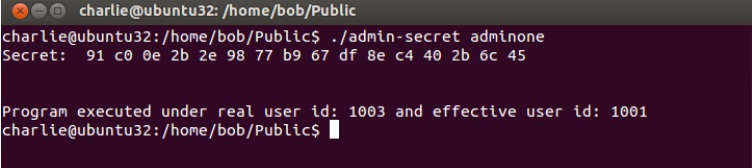
1754_figure2.jpg

Again, as in previous problems, this attack must be successfully executed when logged in as charlie.

The attack should output two lines: the first one contains the application password (the line prefixed by ‘Password:’) and the second one contains the secret of the admin user (the line prefixed with ‘Secret:’).

Assessment

The assessment is based on two components:

1. Attack code execution: This is broken down to 15% for Problem 1, 15% for Problem 2 and 20% for Problem 3. The assessment of the correctness of your attack will be partially automated, so please make sure you follow the suggested output format as mentioned in the problem description above. Your solutions will be tested in the same virtual machine that is provided with this assignment, but with all password and secret values modified (except for charlie’s passwords and secret). So you should make sure that you do not hardcode any of the sample passwords/secrets, other than charlie’s, mentioned above in your solutions, as they will not work in the assessment process. Each attack must be successfully executed within 2 (two) minute. This is really a gross approximation; if you implement the attacks correctly, each attack should take only a few seconds to solve the given problem.

2. Report- There is no definitive structure of the report, but here are some guidelines of what we would expect from the report:

– As a general guideline we expect a division into three parts, corresponding to the division of the problems. But if you are able to find a single attack that solves all problems, in which case, the division per problem does not work so well and the report will be judged more holistically.

– We expect a detailed analysis of what are the vulnerabilities and how you exploit them. It is not enough, for example, to say that you do a ‘stack overflow’ attack. You’d need to explain about the memory layout, what is the effect of the overflow, how do you subvert the control flow of the program, etc. Similarly, where the problem/solution concerns Unix security mechanism, I expect you to articulate clearly the aspects of the control mechanism that cause the vulnerability, and how you exploit them.

Price discrimination strategy of united airlines

Price discrimination strategy of united airlines

Price discrimination strategy of united airlines

Macroeconomics
Price Discrimination: Suppose that United Airlines knows that it faces the
following demand equations and corresponding marginal revenue equations for its
(one-way) SFO to Las Vegas route:

Friday Departure: P = 320-2Q (Demand)

MR = 320-4Q (Marginal Revenue)

Tuesday Departure: P = 200-Q (Demand)

MR = 200-2Q (Marginal Revenue)

Marginal Cost is a constant $40 per passenger.

a) Find the profit-maximizing quantity of passengers for Friday departures and
Tuesday departures. Find the profit-maximizing price for each.

b) Calculate total revenue received on Friday flights and Tuesday flights.

c) Draw two separate graphs for Friday demand and Tuesday demand. In your graph
include a marginal revenue curve and marginal cost curve. Show the profit
maximizing price and output for each graph.

d) What if United Airlines charged $150 per passenger everyday of the week, would
this maximize profits? Why or why not?


Explain the features of secure e-mail

Explain the features of secure e-mail

A company in Manhattan still keeps to the traditional mailing approaches even though the nature of their business strictly involves confidential documents that need to be sent to clients. Tell this Manhattan Company why you think their messages can be securely sent to clients using e-mail.

Write a 2-3 page e-mail that includes the following:

Explain the features of secure e-mail and how secure e-mail works.
As a good consultant, make sure that they are also aware of the vulnerabilities involved in e-mail communication and how they can be countered.
Your paper should be written in the APA style, and should cite any sources you used.

Evaluate Internet Sources Using Structured Approach to Research and Communicate Process to Doctoral Students

Evaluate Internet Sources Using Structured Approach to Research and Communicate Process to Doctoral Students


Evaluate Internet Sources Using Structured Approach to Research and Communicate
Process to Doctoral Students

During Week 1, we examined two types of publications. This week, we turn our focus
toward how to examine resources located on the Internet. Internet searches are much
easier than electronic library searches, but Internet searches present challenges.
For example, many people are not qualified to present objective information, and
they post inaccurate or biased information. The locations can be informal, such as
personal blogs; or they can be more formal, such as on professional organization
websites. The challenge for professional and academic researchers is to ensure the
information retrieved and relied on is accurate and free from excessive bias. This
week, you will practice locating resources on the Internet and analyzing
information for credibility, and creating a presentation to help other doctoral
students evaluate Internet sources.

For this task, begin by locating at least three sources of information from
Internet resources on a business topic of interest to you. The information should
be from a professional organization website or from a website specializing in a
particular subject. Ensure there is an author identified and be sure the
qualifications of the author are presented in the website information.

Next, imagine that you will be creating a PowerPoint Presentation to doctoral
students to help them evaluate sources. Create a visual diagram that reflects the
process steps students need to go through to evaluate Internet sources. Explain
each of the steps in the process in detail and use the three sources you identified
as examples. Be sure to consider the following questions to help your doctoral
student audience understand the validity of the authors you researched.

Who is the author?
What are the main points the author is presenting?
What are the author’s educational and experience credentials? In what way do they
support the author’s ability to express an opinion on the subject?
Has the research been peer-reviewed or gone through an editorial process?
What types of bias may be present?
Who has a contrary opinion on the subject, and what are their credentials?
How old is the material, and is it still relevant?
End your PowerPoint presentation by providing a real-life example from a specific
business context where you could apply the Internet source evaluation process you
just developed to promote a specific business improvement idea to your management
team. How might the source evaluation process help you build credibility in a
business setting? How is the source evaluation process different in academia verses
a business context?

Incorporate appropriate animations, transitions, and graphics as well as speaker
notes for each slide. The speaker notes may be comprised of brief paragraphs or
bulleted lists.

Support your presentation with at least 3 scholarly resources. In addition to these
specified resources, other appropriate scholarly resources may be included.

Length: 9-12 slides (with a separate reference slide)

Notes Length: speaker notes of 200-350 words per slide.

Be sure to include citations for quotations and paraphrases with references in APA
format and style where appropriate. Save the file as PPT with the correct course
code information

Diagnostic Formulation

Diagnostic Formulation

Field: Psychology

Diagnostic Formulation

Review the case given below case study (Psychological Evaluation for Jessica E.
Smith) for this required assignment (RA). On the basis of the information in the
case study, provide a principal (primary) and a secondary diagnosis for the person
using the most recent DSM codes. You will also discuss your diagnoses in narrative
(paragraph) form. Then, identify and discuss at least one differential (possible
alternate) diagnosis for the principal diagnosis and at least one differential
(possible alternate) diagnosis for the secondary diagnosis that you gave. Lastly,
discuss whether a diagnosis from other conditions that may be a focus of clinical
attention is warranted.

While you are welcome to list medical conditions that might be a concern, your
primary and secondary diagnoses should be psychological conditions listed in DSM-5.

Your paper should have separate sections for:

Principal and secondary diagnoses
The reasons for selecting the principal and secondary diagnoses
Social and cultural factors that may influence the principal and secondary
diagnoses
Differential diagnoses, including a consideration of whether a diagnosis from other
conditions are applicable
The reasons for selecting the differential diagnoses
Your rationale and justification for why your actual diagnoses are a better fit
than your differential diagnoses


Need an Article on Critique & Scholarly Activity/ Human Resource Management Article Critique:

Need an Article on Critique & Scholarly Activity/ Human Resource Management Article Critique:


Need an Article on Critique & Scholarly Activity/ Human Resource Management
Article Critique:

The Brisson-Banks (2010) article in the required reading for this unit compares the
five different change management models presented in this unit, and it describes
various situational variables that could influence the effectiveness of each. Write
a critique of the article.

Brisson-Banks, C. (2010). Managing change and transitions: A comparison of
different models and their commonalities. Library Management, 31(4), 241-252.


In your paper, be sure to include the following:

• Evaluate different aspects of organizational change. • Discuss the role that
leader vision and organizational climate plays in a change management strategy. •
Discuss how effective change initiatives can influence organizational performance.


Be sure to follow the guidelines below:

• Accurately identify the premise and supporting points from the article. • Provide
an insightful and thorough analysis of information from the article, including
using evidence and reasonable and compelling interpretations. • Link material to
course content and real-world situations. • Demonstrate solid critical evaluation
by providing well-supported opinions and conclusions using additional peer reviewed
articles. • Organize the material logically by using smooth transitions and
grouping similar material together. • Your paper should be at least two pages in
length. • All sources used must be referenced; paraphrased and quoted material must
have accompanying citations in APA format.


2. Scholarly Activity:

Find two articles on information systems best practices. Discuss some of the key
issues to be aware of and the best practices to mitigate them.

• Discuss strategic analysis decisions in the next five years, what we need to
watch out for in the information technology (IT) field, and how these decisions
will impact the overall company. • Examine potential changes in IT related to
innovation and organizational processes. • List and describe internal (online)
information security risks and mitigation tactics and how they will affect
decision-making strategies. • List and describe external (building) information
security risks and mitigation tactics and how they will affect decision-making
strategies

Change Management/Business Finance – Operations Management

Change Management/Business Finance – Operations Management

Change Management/Business Finance – Operations Management

The EHR really changes how people do their jobs, and change management is needed.
However, change management may look different for a team of medical records clerks
versus an orthopedic surgeon.

You were hired to put together a change management plan for each of these employees
or groups of employees at Rasmussen Hospital. Write a brief Change Management Plan
for each scenario given, using the four R’s shared in the Change Management reading
in this class. Be sure to address any fears or concerns the employees may have.

SCENARIO ONE: Medical Records Clerical Team

This team of five spent most of their day pulling paper medical record folders off
of shelves, pulling paper out of them, filing paper back into them, and putting the
folders back on the shelves. The folders could be thin or very thick. The job
involved bending down to very low shelves or stretching up to high shelves. They
also had to push carts from place to place, delivering and picking up charts from
clinics. With the new EHR, all of the paper will be scanned into the EHR, and they
will no longer be using paper charts. They will need to learn to use the computer,
which many of them have not done before. Their new jobs will involve scanning paper
records received by the clinic, and keying in the Medical Record Number so that the
scanned document goes into the correct patient’s record. Accuracy will be very
important.

SCENARIO TWO: Dr. John Smith, Orthopedic Surgeon

Dr. Smith is an orthopedic surgeon who has been working at the hospital for 30
years and is 10 years from retirement. He does not like to use computers. His
normal workflow is to see patients, dictate his notes into a tape recorder, and
send the tape to a transcriptionist who will type the note on paper. The paper is
delivered to his office three days later for his signature. It often sits on his
desk for several days before he signs it, and then it is picked up by a medical
records clerk and filed to the medical record. With the EHR, Dr. Smith will be
expected to use a computer template with picklists, checkboxes, and free text in
the patient’s record in the EHR to create his patient documentation himself,
meaning they will be available immediately instead of three days later. He will no
longer be able to dictate. He is not very happy about this as he is not used to
using a computer, and he feels that this will add a lot more time to his day and
take time away from the patient. He does not understand what benefits the EHR will
bring to the organization. He is very busy and does not have time for long training
classes.

SCENARIO THREE: Lab Technicians

There are 10 lab technicians. Their current work flow is that the patient comes to
get their blood drawn. The lab tech takes their blood and puts a hand printed label
on the tube. When the lab is completed, the results go into the Lab System, and are
printed on paper out of the lab system. The paper is sent to Medical Records to be
filed in the chart. The lab technician will have to call the doctor with the lab
results if they are important and need to be known immediately. With the EHR, the
patient will come to the lab with a label already preprinted with their information
on it. The label will be placed on the tube. The Lab System will have an HL7
Interface into the new EHR, (You will learn more about HL7 in the following
module.) and the results will flow electronically right from the Lab System into
the EHR via the interface, so no paper will have to change hands, and the lab
results will go right to the patient’s chart and be ready for the doctor to review
online. If the lab results are important, they will send an urgent message to the
doctor’s in basket and may even automatically page the doctor.


48